

7 min read
In this guide
Stabilization media are sold in the volumes and tube formats that suit a supplier’s packaging line, not your assay. If your validated protocol calls for a different fill volume, a different tube, or a different closure than the catalog offers, you have three options: change your assay to fit the packaging, accept a compromise that shows up in your data, or have the medium filled to your specification. The third option is the one most kit companies do not know exists.
What “stock” actually means
A catalog collection tube is a fixed combination of four things: the medium, the fill volume, the tube geometry, and the closure. Suppliers optimize that combination for manufacturing efficiency across their whole customer base. It is a reasonable business decision and it produces a good product for the median use case.
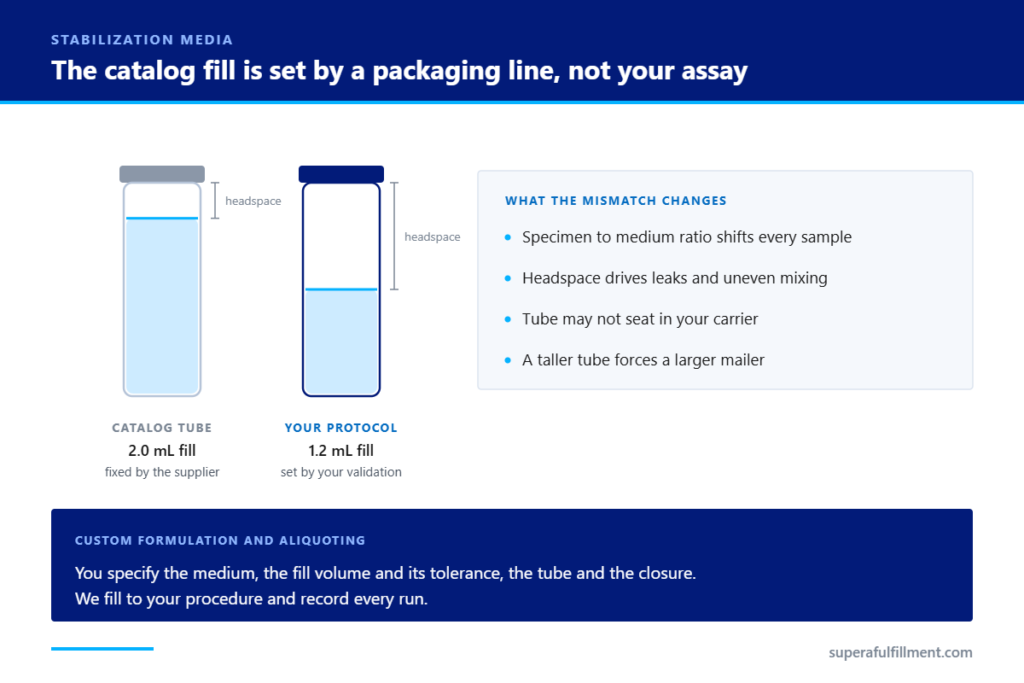
Your assay is not the median use case. Specimen-to-medium ratio is a validated parameter. So is headspace. So is the internal diameter your instrument’s probe expects. When the catalog fill is 2 mL and your protocol wants 1.2 mL, the mismatch is not cosmetic.
Four problems it causes
Dilution ratio drift. Specimen-to-medium ratio drives preservation performance and downstream extraction yield. A fill volume that does not match your validation shifts the ratio for every sample. You do not see it as a failure. You see it as a wider distribution in your results and a higher invalid rate.
Headspace and transport stress. Fill volume determines headspace, and headspace determines how a tube behaves under pressure change and agitation in transit. Overfilled tubes leak. Underfilled tubes let the specimen slosh across the medium unevenly. Both outcomes arrive at the laboratory as a rejected sample and at your support team as a replacement kit request.
Automation mismatch. Tube height, diameter, skirt, and cap geometry decide whether a tube seats in your laboratory’s carrier and whether a probe can reach the bottom of the fluid. Buying the medium in whatever tube the supplier offers means either buying racks and adapters around it or transferring every sample by hand on receipt.
Kit bulk and cost per shipment. A tube sized for a laboratory bench is often too tall for an at-home mailer. The kit grows, the mailer moves up a size, and the shipping cost of every unit rises for the life of the program. That is a permanent cost created by a packaging decision made by someone else.
What custom formulation and aliquoting means
It means buying a known medium in bulk and filling your specified volume into your specified tube, per your written procedure, with lot control and records for every fill.
In practice:
- You specify the medium. Common examples include DNA and RNA stabilization buffers, nucleic acid preservation solutions such as Zymo DNA/RNA Shield, sterile saline, and transport media.
- You specify the fill volume and the tolerance.
- You specify the tube and closure. Capillary and microsampling formats such as BD Microtainer, Sarstedt Microvette, and Greiner MiniCollect are all in play, as are standard screw-cap tubes and cryovials.
- You supply the procedure and the acceptance criteria, or we build them with you and you approve them.
- Filling runs under a controlled work instruction with in-process fill weight or volume verification, lot assignment, and a documented release against your criteria.
At Supera this runs on a Hamilton Microlab STAR liquid handler inside an ISO Class 7 cleanroom. Automated dispensing gives a tight fill tolerance across a full run and produces a record for the run rather than a technician’s word for it.
What you need to bring
The work is straightforward when the inputs are complete. It stalls when they are not. Have these ready:
| Input | Detail needed |
|---|---|
| Medium | Named product and grade, or your formulation with a mixing procedure |
| Fill volume | Target and acceptable tolerance, stated as a range |
| Container | Tube and closure by manufacturer part number, with any label placement requirement |
| Procedure | Your SOP, or approval of one we draft |
| Acceptance criteria | How a filled unit passes or fails, and who signs release |
| Labeling | Content, lot format, and expiration convention |
| Storage and shelf life | Conditions and the stability basis you are relying on |
| Volume and cadence | Units per run and expected frequency, so the run is sized correctly |
The two that most often go missing are tolerance and shelf life basis. A fill volume without a tolerance cannot be verified. A shelf life without a stability basis is a number on a label.
Where it changes the kit, not just the tube
Filling to your specification opens design choices that are closed when you buy catalog units. A smaller fill lets you use a shorter tube, which lets you use a smaller mailer, which lowers cost per shipment permanently. Matching tube geometry to your laboratory’s carrier removes a manual transfer step from every received sample. Filling two media into two tubes in one kit lets you collect for two assays from one patient interaction, which is often the difference between a program a patient completes and one they abandon.
This is why we treat formulation and aliquoting as part of kit design rather than a service bolted on afterward. The tube decision drives the mailer, the mailer drives the shipping cost, and the shipping cost drives whether the program works at your price point.
What gets verified on a fill run
A fill is only worth something if it is measured. On a controlled run, these are the checkpoints that produce the record:
| Checkpoint | What is recorded |
|---|---|
| Bulk medium receipt | Supplier lot, quantity, condition, expiration, and release to production |
| Container receipt | Tube and closure lot, part number, and incoming inspection result |
| Instrument setup | Method used, deck layout confirmed, operator, date |
| Fill verification | Volume or weight checks at defined intervals across the run, against your stated tolerance |
| Closure and seal | Torque or seating check per your criteria |
| Labeling | Label proof, lot number, expiration, and a verification against the approved artwork |
| Release | Pass or fail against your acceptance criteria, with the name of the person who released it |
Every filled unit carries a lot number that traces back to the bulk medium lot and the container lot. If you ever need to hold product, you can hold exactly the affected units instead of everything you have shipped.
Questions we get asked
What is the smallest volume you will fill?
Microsampling formats routinely call for fills well under 1 mL, and automated dispensing handles that range with a tighter tolerance than hand filling. The practical limit is usually the tube geometry and your tolerance, not the volume itself. Bring both and we will tell you whether it is achievable.
Can you fill a medium we formulate ourselves?
Yes, with your mixing procedure, your acceptance criteria, and a documented basis for stability. You own the formulation and the validation. We fill to your procedure and record what we did.
Do you handle stability testing?
No. Stability and shelf life are yours to establish, typically with a laboratory partner. We will build the fill and labeling to the shelf life you set and will hold retained samples if your protocol calls for it.
Can you fill into a tube we already buy?
Usually yes. Send the manufacturer part number for the tube and closure. Tube compatibility with automated dispensing is confirmed before a production run, not assumed.
What it does not change
Filling a medium to your specification does not alter the regulatory status of your product and does not make a claim about performance. Stability, validation, and the regulatory classification of your kit and your specimen remain yours to establish. We build to your procedure and document what we did. We do not make your determination, and you should be skeptical of any manufacturer who offers to.
Supera Fulfillment fills and aliquots stabilization media on a Hamilton Microlab STAR in an ISO Class 7 cleanroom under an ISO 13485 certified quality system in Houston, Texas. See our aliquoting services, our integrated collection and stabilization kits, our work as a specimen collection kit contract manufacturer, and the capillary blood devices we build kits around.
More on this: Opening international specimen lanes and Why prepaid return labels fail in the field.