8 min read
In this guide
The three terms are not interchangeable, and the difference decides who is responsible when a kit is wrong. A 3PL moves and stores your product. A fulfillment vendor picks, packs, and ships it. A contract manufacturer makes it. Only the third one produces a finished device, holds a device quality system for that operation, and creates the manufacturing record you will need during an investigation.
The same kit, bought three different ways. What changes is who is responsible when it is wrong.
| Fulfillment vendor | Healthcare 3PL | Contract manufacturer (Supera) | |
|---|---|---|---|
| What you are buying | Pick, pack and ship | Compliant storage and movement | Manufacture of the kit itself |
| Quality system | None required | Commonly ISO 9001, written for storage and handling | ISO 13485:2016 certified QMS covering kitting, labeling, repackaging and solution filling |
| Regulatory registration | None | Varies, often none for device manufacturing | FDA-registered device establishment, Manufacturer activity declared |
| Manufacturer of record | You | You | Supera, for the operations it performs. You remain the specification developer and label owner unless agreed otherwise |
| Production environment | General warehouse | Warehouse, often temperature mapped | ISO Class 7 cleanroom for aliquoting and solution filling, plus climate controlled warehouse |
| Lot traceability | Order number | Inbound and outbound lot | Lot traveler carrying every component lot, certificate of conformance, quantity used, QC signature and QA release |
| Inspection | Spot check at pack out | Receiving inspection | Four documented checkpoints against an AQL sampling plan. A failed sample escalates to full inspection of that item |
| Change control | Informal | Informal | Written change control. No material, process or artwork change without documented approval |
| What you get on paper | Packing slip | Storage and shipping records | Approved SOP, BOM approval, lot records, QC forms and release documentation |
| When something goes wrong | Credit or reship | Investigation of handling | Documented deviation, root cause, corrective action and verification of the fix |
| When your client audits you | Nothing to produce | Storage and handling records | Controlled documents and lot history on request, retained five years past expiration |
Supera Fulfillment is an FDA-registered device manufacturer, ISO 13485:2016 certified by NSF-ISR, operating an ISO Class 7 cleanroom in Houston, Texas. Registration is not clearance or approval. Inspection level on any program is set by the governing procedure, the agreed sampling plan and the client requirement.
Most companies buying kit services discover this distinction late, usually during a nonconformance or an audit. Here is the plain version.
What a 3PL does
A third-party logistics provider handles movement and storage. Receiving, warehousing, inventory management, transportation, and often freight brokerage. The value is network, space, and rate leverage.
A 3PL takes your finished goods as they arrive and gets them where they need to go. It does not create the product. Its records answer where something is and where it went. They do not answer what is inside it or who verified that.
Many healthcare 3PLs are competent and some hold quality certifications for storage and distribution. That is a real capability. It is a different capability from manufacturing.
What a fulfillment vendor does
A fulfillment vendor sits one step closer to the product. It stores your components or finished units, picks against orders, packs them, applies labels, and ships. In consumer categories this is the whole job and it is done well by thousands of operations.
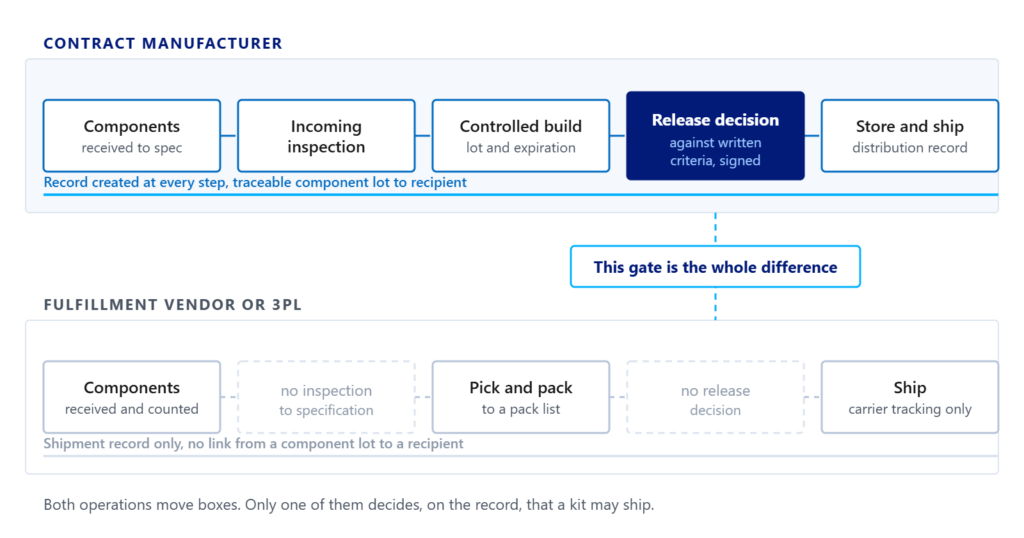
Where it breaks down in diagnostics is release. A fulfillment vendor assembles to a pack list. A contract manufacturer builds to a specification and then makes a release decision against written criteria. Those are different activities even when the physical motions look identical from across the room.
The tell is what happens when a component looks wrong. A fulfillment operation escalates it as a picking exception. A manufacturing operation opens a nonconformance, quarantines the lot, and stops the line.
What a contract manufacturer does
A contract manufacturer produces the finished product to your specification, under a quality system, with records for every unit made.
For a specimen collection kit that means:
- Component qualification and incoming inspection against a specification, not just a receiving count.
- A controlled bill of materials and a work instruction that has been approved and trained.
- Lot control and expiration control on every component, carried through to the finished kit lot.
- In-process verification and a documented release decision before the kit is available to ship.
- Traceability in both directions: from a component lot forward to every finished kit and recipient, and from a single recipient complaint backward to the exact configuration that shipped.
- Nonconformance, deviation, CAPA, complaint handling, change control, and recall procedures that have been exercised.
Some contract manufacturers also do the value-added work that no logistics operation touches: filling stabilization media to a client-specified volume, aliquoting into a client-specified tube, and building integrated collection and stabilization kits rather than boxing what a supplier ships.
The line that matters
Assembling components into a finished collection kit generally makes that kit a device. The operation performing the assembly is a manufacturing operation, and the facility registers with FDA as a device establishment on that basis. Registration is a listing obligation. It is not clearance and it is not approval.
As of February 2, 2026, FDA’s Quality Management System Regulation incorporates ISO 13485:2016 by reference into 21 CFR Part 820. That is the framework a kit manufacturing operation is measured against. A storage and transportation provider is measured against a narrower set of expectations, because it is doing a narrower job.
So the question to ask is not “are you certified.” It is “what does your certificate cover, and does it cover the thing you are about to do for me.”
Side by side
| Capability | 3PL | Fulfillment vendor | Contract manufacturer |
|---|---|---|---|
| Stores and ships your product | Yes | Yes | Yes |
| Picks and packs to order | Sometimes | Yes | Yes |
| Builds finished kits to a controlled specification | No | Rarely | Yes |
| Incoming inspection against component specifications | No | No | Yes |
| Component lot and expiration traceability into finished kit lots | No | Rarely | Yes |
| Documented release decision before shipment | No | No | Yes |
| Nonconformance, CAPA, and change control on the build | No | No | Yes |
| Media filling and aliquoting to your specification | No | No | Some |
| Registered as a device establishment for the assembly operation | No | No | Yes |
How to tell which one you are talking to
Sales language converges. Capability does not. Six questions separate them fast.
- Show me a kit history record for a lot you built last month.
- What is your incoming inspection specification for a collection device, and who wrote it?
- Who signs the release decision on a finished kit lot, and against what criteria?
- Give me one component lot number and tell me every finished kit and recipient it reached.
- Walk me through your last nonconformance on a build, including the disposition.
- What triggers a change notification to me, and how long before the change takes effect?
A contract manufacturer answers all six from records. A fulfillment operation answers one or two and reframes the rest as logistics questions.
Which one you actually need
- Finished kits arrive from a manufacturer and you need storage and distribution. A 3PL or a healthcare fulfillment provider is the right fit and the cheaper answer. Do not overbuy.
- Consumer product, no specimen, no regulated device. A fulfillment vendor is fine.
- You specify a collection kit and someone else builds it. You need a contract manufacturer. Component sourcing, lot control, release, and traceability are the job, not add-ons.
- Your kit has a specimen return. You need manufacturing controls plus a validated return path. Specimen shipments generally move under UN3373 with IATA Packing Instruction 650 unless you have documented an exemption or a Category A determination, and that determination is yours to make.
- Your kit needs a stabilization medium at a volume no supplier sells. You need a contract manufacturer that fills and aliquots. Very few do.
The hybrid case, and why it usually is not one
Providers frequently describe themselves as all three at once. Sometimes that is accurate, because a single company can hold a device quality system for kit assembly and also run storage and distribution. More often it means the company does logistics well and does assembly on the same floor without the controls that make assembly manufacturing.
Two structures are genuinely common and worth naming, because they are not the same thing:
- Manufacturer that also distributes. The kit is built under a quality system, released, then stored and shipped by the same operation. One record chain, one point of accountability. Simpler to audit.
- Manufacturer plus separate 3PL. Kits are built and released at one site, then transferred to a logistics provider for storage and shipment. This works, but the handoff becomes a control point. You need distribution records that reconcile across two systems, and you need to know who owns a decision about a damaged return.
What does not work is a single vendor that treats the boundary as invisible. If nobody can tell you where release happened and who signed it, release did not happen.
Questions we get asked
Is a 3PL allowed to assemble kits?
Assembly is a manufacturing operation, and the facility performing it takes on manufacturing obligations regardless of what the company calls itself. Some logistics providers have built real device quality systems to support that work. Many have not. The certificate scope tells you which.
Can I use a fulfillment vendor if my kit is not a device?
Often yes, and it will cost less. Confirm the classification with your own regulatory counsel first, and be honest about whether a specimen return is involved, because a returning biological specimen brings requirements even when the outbound kit is simple.
What single document separates the categories fastest?
The kit history record for a lot the provider built last month. A contract manufacturer produces one in minutes. A fulfillment operation will offer a pick ticket and a shipping manifest instead.
Does contract manufacturing cost more per kit?
Per kit, usually yes, because the price includes component qualification, lot control, verification, release, and record retention. Per program, it is frequently cheaper, because it removes replacement kits, invalid samples, and the cost of a recall that could not be targeted.
Why the labels matter commercially
Buying the wrong category costs money in both directions. Hiring a contract manufacturer to warehouse finished goods means paying manufacturing overhead for storage. Hiring a fulfillment vendor to build a regulated kit means discovering, during your first complaint investigation, that the records you need were never created. The second mistake is far more expensive than the first.
Most fulfillment companies are logistics operations that learned healthcare. Supera was built the other way around.
Supera Fulfillment is an ISO 13485 certified, FDA registered device manufacturer in Houston, Texas. See our work as a specimen collection kit contract manufacturer, our medical kitting services, our at-home test kit manufacturing and fulfillment programs, and our aliquoting capability.