

7 min read
In this guide
- What the two formats actually are
- The hematocrit problem, and why “VAMS eliminates it” is only half true
- What that means for your validation
- The regulatory question US programs get surprised by
- The comparison that actually matters
- Questions to answer before you choose
- What the format decision does to the kit
Both formats dry a small volume of capillary blood onto a substrate and ship it ambient. The marketing says one of them solved the hematocrit problem. The published validation data says it solved half of it, and which half matters more depends on your analyte.
What the two formats actually are
A dried blood spot card is filter paper. The user drops blood onto a marked circle, it wicks outward and dries, and the laboratory punches a fixed-diameter disc out of the spot to analyze. The punch is a fixed area of paper, not a fixed volume of blood.
Volumetric absorptive microsampling, usually shortened to VAMS, replaces the paper circle with a small porous tip on a plastic handle. The tip absorbs a fixed volume by capillary action, commonly in the ten to thirty microlitre range, then dries. The laboratory extracts the whole tip. VAMS is a technique rather than a single product, and more than one commercial device implements it.
The hematocrit problem, and why “VAMS eliminates it” is only half true
Hematocrit is the fraction of blood volume made up of red cells. It varies widely between patients, and it causes two separate problems that get collapsed into one phrase.
The first is a volume problem. On a card, blood with a high hematocrit is more viscous and spreads less, so a fixed punch taken from a small dense spot contains more blood than the same punch from a large thin spot. Your fixed-area punch is not a fixed dose. This is the classic dried blood spot bias, and it is real.
VAMS genuinely fixes that one. The tip takes up a set volume regardless of how the blood behaves, so the amount of blood entering the assay stops depending on the patient.
The second problem is a recovery problem, and VAMS does not fix it by design. Getting the analyte back out of a dried matrix depends on how that analyte is distributed between plasma and red cells, and on the extraction chemistry. For compounds that bind heavily to red cells, recovery from the tip still varies with hematocrit even though the volume is now fixed.
The published work is direct about this. A review of VAMS in therapeutic drug monitoring notes that the device manufacturer stated hematocrit level did not influence sample recovery, while independent validation studies found otherwise. In one everolimus evaluation across hematocrit values of 0.20, 0.45 and 0.65, reported bias at the low and high ends ranged from roughly negative 20 percent to positive 31 percent across the quality control range. The same review records one study concluding that in its clinical context the VAMS technique performed worse than dried blood spot, and states plainly that the hematocrit effect and its influence on extraction should be evaluated in every validation.
Extraction chemistry turns out to carry a lot of the outcome. Protocols using water as the extraction solvent showed minimal hematocrit effect on tacrolimus recovery in some reports, while organic solvents sometimes made it worse. That is a method development finding, not a device property, which is the point.
What that means for your validation
Choosing VAMS does not let you skip the hematocrit work. It changes which part of it you have to do.
- Validate across a clinically relevant hematocrit range, not just a mid-range control. The literature commonly spans roughly 0.20 to 0.65.
- Evaluate recovery, not only precision. Precision can look excellent while recovery drifts with hematocrit.
- Treat extraction solvent and technique as variables to develop, not settings to inherit from an application note.
- Decide in advance what bias you will accept. A common threshold in the reviewed work is plus or minus 15 percent, beyond which a correction approach gets introduced.
- If your analyte binds strongly to red cells, expect to do more work, whichever format you pick.
- Consider whether you can measure or estimate patient hematocrit alongside the result, because that is what makes a correction possible.
The regulatory question US programs get surprised by
This is the item that changes program plans, and it is easy to miss because it varies by device and by territory.
Trajan Microsampling, formerly Neoteryx, publishes the regulatory status of its own devices in its FAQ. As written there, Mitra is CE-IVD in the EU, UK and certain other markets and research use only in the United States, while its hemaPEN device is listed as CE-IVD in the EU, UK, Australia and the USA and research use only elsewhere. Statuses change and differ by configuration, so confirm the current position with the manufacturer in writing and put it in front of your own regulatory lead before you design a program around it.
The practical consequence: a device that is research use only in your market is not a shortcut into a clinical workflow. If your program returns results to patients or clinicians in the United States, that status is a design constraint on day one, not a paperwork detail at launch.
The comparison that actually matters
- Volume delivered to the assay. Card: variable, set by how the spot spread. VAMS: fixed by design.
- Hematocrit bias. Card: volumetric and recovery both in play. VAMS: volumetric solved, recovery still analyte dependent.
- User technique sensitivity. Card: users under-fill circles, layer drops, and touch the paper. VAMS: users can under-fill a tip by lifting it early, which is a different failure and easier to see.
- Unit cost. Card: the cheapest dried format there is. VAMS: meaningfully higher per unit, which matters at volume.
- Assay characterization maturity. Card: decades of published methods for the analytes it is used for. VAMS: strong and growing, but thinner for any given niche analyte.
- Laboratory handling. Card: punch workflow, familiar almost everywhere. VAMS: whole-tip extraction and racked automation formats, which suits higher throughput but may need instrument work.
- Kit footprint. Card: flat, mails in an envelope. VAMS: a rigid handle and a desiccant pouch, which changes the box.
- Patient experience. Both are a fingerstick. Neither removes the fingerstick.
Questions to answer before you choose
- What is the analyte, and how strongly does it partition into red cells?
- Has your laboratory already validated either format for it, or are you funding that work?
- What volume does the assay actually need, and does the format deliver it with margin?
- What regulatory status does the device hold in the market you are launching into, and who confirmed it?
- What completion and rejection rate can the program tolerate?
- At your annual volume, what does the unit cost difference come to, and does it change the business case?
- Does the format need cold chain, or does dried ambient shipping hold for your stability window?
What the format decision does to the kit
The choice does not end at the device. A dried format only works if the kit protects the drying step and the transit that follows.
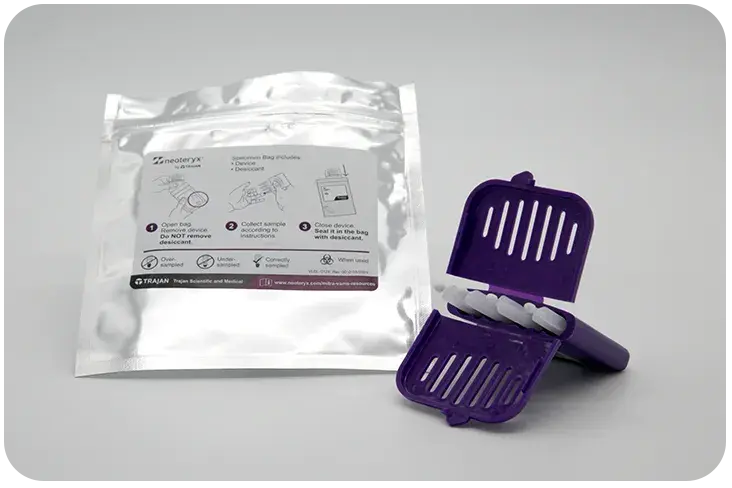
That means a desiccant matched to the pouch volume rather than whichever sachet was on the shelf, instructions that state a drying time the user will actually wait out, a pouch that seals reliably in a kitchen, and a return path with a label that will still be honored when the specimen finally gets dropped off. The last one is where more programs lose samples than lose them to hematocrit.
Both formats also need the same thing from the assembly side: lot and expiry capture on the collection component, because a dried microsample with an unknown device lot is a finding waiting to happen.
Related reading: Capillary collection or venipuncture and How to choose a preservation medium.
Sources: Trajan Microsampling FAQ and microsampling blog for device descriptions and stated regulatory status; Kindem and colleagues, Volumetric Absorptive Microsampling in Therapeutic Drug Monitoring of Immunosuppressive Drugs, for the hematocrit, recovery and validation findings. Device regulatory status is the manufacturer’s to state and yours to verify; nothing here is a determination by Supera Fulfillment.
VAMS fixes the volume problem, and that is a real advance. It does not hand you a hematocrit-free assay. Pick the format your analyte and your laboratory can actually validate, then build the kit so the drying and the return path do not undo the work.