
Cold Chain Logistics for Diagnostic Specimens and Medical Kit Distribution
Supera Fulfillment provides cold chain logistics services to diagnostic laboratories, clinical research organizations, at-home testing brands, and medical kit programs across the United States. Operating from our FDA-registered, ISO 13485 certified facility in Houston, Texas, we manage temperature-controlled storage, cold chain kit assembly, and temperature-qualified shipping for specimen collection materials, biological samples, reagents, and diagnostic products that require refrigerated or frozen handling from receipt through final delivery.
What Cold Chain Logistics Means in a Laboratory Context
Cold chain logistics is the management of a product’s temperature environment across every stage of its supply chain, from inbound receipt and warehousing through kit assembly and outbound distribution. In diagnostic and life sciences applications, a cold chain failure is not a shipping inconvenience. It is a pre-analytical event that degrades sample integrity, compromises reagent performance, and in regulated programs, constitutes a deviation that requires investigation and documentation.
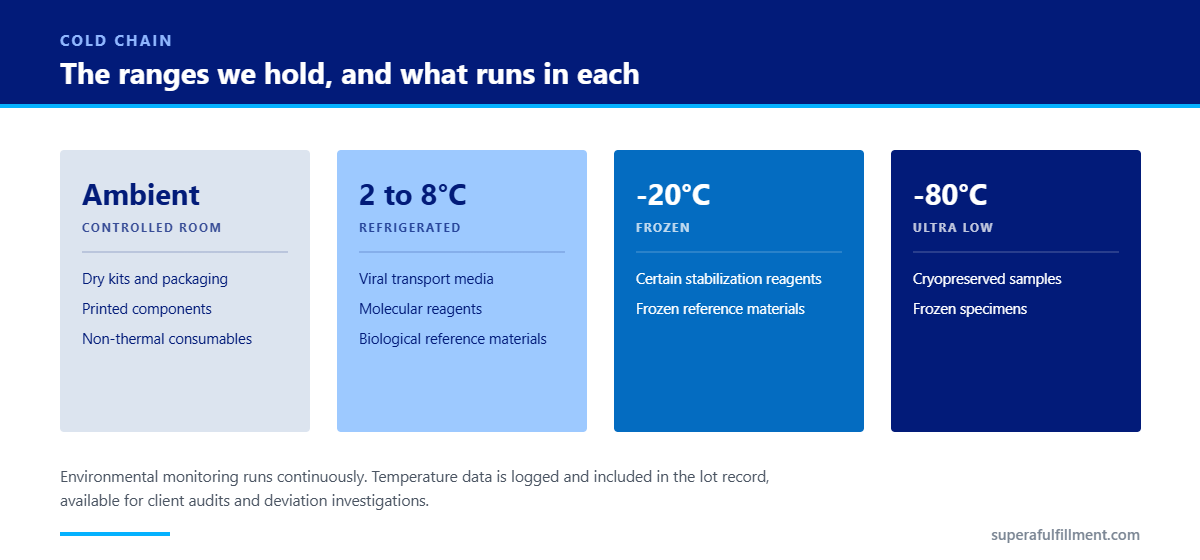
The cold chain requirements for diagnostic products span a wide range. Viral transport media, molecular reagents, and biological reference materials may require refrigerated storage between 2°C and 8°C. Frozen specimens, cryopreserved samples, and certain stabilization reagents require storage at -20°C or -80°C. Some products (including many molecular transport media formulations from Zymo Research and ambient-stable collection devices from Tasso and Trajan Microsampling (formerly Neoteryx)) are engineered specifically to reduce or eliminate cold chain requirements during transport, which we also accommodate within broader kit programs.
Understanding where cold chain is genuinely required versus where it has been assumed without validation is part of the clinical laboratory expertise Supera brings to every program.
Our Cold Chain Infrastructure
Temperature-Controlled Storage
Our Houston facility maintains dedicated climate-controlled storage zones covering refrigerated and frozen temperature ranges. Environmental monitoring runs continuously, with temperature data logged and available as part of our quality documentation. Storage conditions are included in lot records for products with temperature-sensitive regulatory requirements, supporting client audits and deviation investigations.
Cold Chain Kit Assembly
Many specimen collection kits require temperature-controlled components to be incorporated during assembly: pre-filled transport media tubes, refrigerated reagents, or frozen reference materials that must stay within defined temperature ranges throughout the build process. Our ISO 7 cleanroom assembly operation manages these requirements at the component level, with assembly workflows designed to minimize thermal excursion between storage and packaging.
For programs using our Hamilton STAR automated liquid handling system for aliquoting, temperature-sensitive media is handled under controlled conditions from bulk storage through dispensing into final containers, with gravimetric verification and environmental monitoring records accompanying every lot.
Temperature-Qualified Shipping
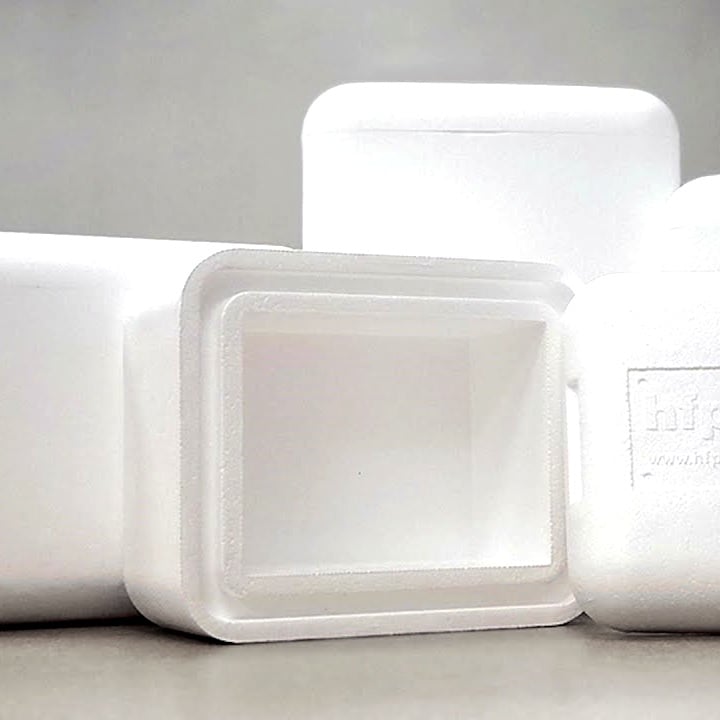
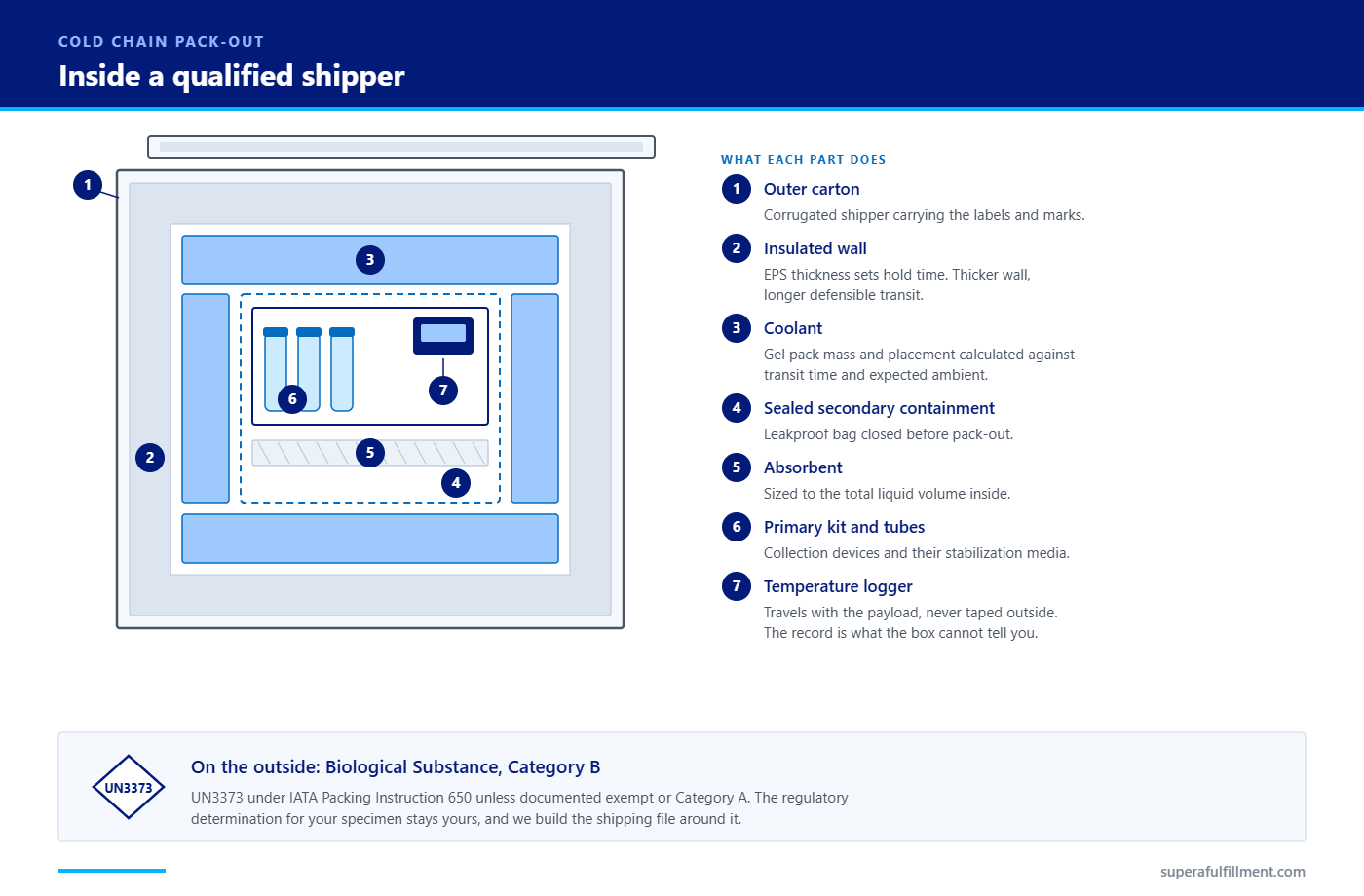
Outbound cold chain distribution is coordinated through temperature-qualified shipping carriers and packaging systems appropriate for the product's required temperature range and transit time. Refrigerated shipments use validated insulated packaging with appropriate gel pack or dry ice configurations. Frozen shipments use dry ice quantities calculated against transit time and ambient temperature conditions. All cold chain shipments include temperature monitoring where required, and documentation is maintained as part of the chain-of-custody record.
We coordinate with FedEx Custom Critical, specialized medical courier networks, and standard carrier cold chain programs depending on shipment requirements, destination, and urgency.
Cold Chain Programs
We Support
Specimen Collection Kit Programs
Diagnostic laboratories and at-home testing brands that include temperature-sensitive components in their collection kits rely on our cold chain assembly and distribution capabilities to maintain product integrity from our facility to the collection site or patient. This includes kits containing pre-filled viral transport media, biological reagents, and any component with a defined storage temperature requirement.
Clinical Trial Logistics
Clinical research organizations require cold chain management that meets ICH guidelines and sponsor-defined temperature excursion policies. We support investigational kit programs with temperature-controlled storage, assembly under defined conditions, and shipment documentation structured for inclusion in trial master files and regulatory submissions. Chain-of-custody records, temperature logs, and deviation reports are available for every shipment.
Reagent and Reference Material Distribution
Laboratories and diagnostic manufacturers distributing temperature-sensitive reagents, controls, calibrators, and reference materials use our regulated storage and distribution infrastructure to manage inbound receipt, storage, and outbound distribution under validated cold chain conditions. Our ISO 13485 certified quality system covers receiving inspection, storage monitoring, and outbound verification, the same quality framework applied to kit assembly programs.
Biological Sample Management
Research institutions, biobanks, and clinical programs managing biological specimens for downstream analysis require cold chain handling that protects sample integrity from collection through storage and distribution. We manage refrigerated and frozen sample logistics with full chain-of-custody documentation and temperature records appropriate for regulated research and clinical applications.
Why Cold Chain Competence Requires Laboratory Expertise
Most third-party logistics providers can move cold freight. What they cannot do is make informed decisions about where cold chain is required, how temperature excursions affect specific analytes, what documentation a regulatory submission requires, or how a shipping failure translates into a pre-analytical deviation in a laboratory quality system.
Supera Fulfillment was co-founded by Sitara Waidyaratne, a clinical laboratory professional with 25 years of experience managing the pre-analytical variables that determine whether a specimen produces a valid result, and Michael Brown, a scientist and laboratory supply veteran with more than 25 years in the industry. That background is the reason our cold chain program is built around laboratory quality requirements, not just freight temperature specifications. Since 2020, our cold chain infrastructure has been tested across the full range of diagnostic program types, from early-stage DTC health brands to established clinical laboratory networks.
Frequently Asked Questions
Our facility maintains refrigerated storage zones operating between 2°C and 8°C and frozen storage at -20°C. For programs requiring -80°C storage, contact us to discuss requirements and availability. All storage zones are continuously monitored with logged temperature data available as part of quality documentation.
Yes. We handle the complete cold chain workflow: inbound receipt of temperature-sensitive components, controlled storage, cold chain kit assembly in our ISO 7 cleanroom, and temperature-qualified outbound shipping. Clients do not need to coordinate separate vendors for storage, assembly, and distribution.
We coordinate with FedEx Custom Critical, specialized medical courier networks, and standard carrier cold chain programs depending on the product's temperature requirements, destination, and required transit time. Packaging configurations (insulated shippers, gel packs, dry ice) are selected based on validated transit time and ambient temperature conditions.
Yes. Temperature monitoring records, chain-of-custody documentation, and deviation reports are available for cold chain shipments in regulated programs. This documentation is structured to support clinical trial regulatory submissions, ISO 13485 quality audits, and laboratory quality system requirements.
Temperature-sensitive components are transferred from controlled storage to our ISO 7 cleanroom assembly area under workflows designed to minimize thermal excursion. Assembly is completed and products are returned to cold storage or packaged for cold chain shipment within defined time windows. Environmental monitoring and assembly records accompany every lot.
Yes. Direct-to-patient cold chain distribution is one of the most common applications we support. Kits containing temperature-sensitive components are assembled and shipped to patients with appropriate cold chain packaging and instructions for handling upon receipt. Return shipping with cold chain packaging is also available for programs requiring sample return to the laboratory.
Yes. We support investigational kit programs with temperature-controlled storage, assembly under defined conditions, and shipping documentation structured for trial master files. Chain-of-custody records and temperature logs are provided with every shipment and are formatted to meet sponsor and regulatory requirements.
Our health fulfillment center maintains FDA registration with ISO 13485 certification for quality management systems. We operate under ISO 7 cleanroom standards for products requiring contamination control. Our healthcare fulfillment services procedures align with FDA regulations including proper documentation, device history records, complaint handling, and returns processing with regular audits and continuous training.
Related reading
Practical guidance from our team on building and running kit programs.
- Opening International Specimen Lanes: A Case StudyHow a new international lane gets screened and opened.
- Why Prepaid Return Labels Fail in the FieldWhy prepaid return labels expire and what it costs.
- How to Choose a Preservation Medium for an At-Home Collection KitMatching preservation chemistry to the analyte and the lane.